
The Link Between Marketing, Sales, and Team Performance (That Most SMEs Miss)


For advisors, consultants, and agencies working with SMEs, the same challenge comes up again and again.
Businesses are busy. Teams are active. Activity is everywhere. But results? Inconsistent.
Marketing, sales, and team performance are all recognised as critical to growth, yet in many SMEs they are managed separately - with different priorities, different measures of success, and little shared structure.
At first glance, this might seem manageable. After all, each function has its own role to play. But over time, this separation creates friction, inefficiency, and missed commercial opportunities. So what is really going wrong, and how can businesses fix it?
The real issue is not a lack of effort – it’s an alignment problem.
Because marketing and sales alignment is not just “nice to have.” It’s fundamental to a successful SME marketing strategy and overall business performance.
The Problem: Three Functions, Three Independent Teams
It’s a familiar picture in many SMEs.
Marketing is busy creating campaigns, content, and communications. The sales team is focused on conversations, targets, and closing deals. Meanwhile, the wider team is delivering products, managing customers, and keeping operations moving.
Individually, people are working hard. Collectively, things don’t always connect.
This often shows up as:
Friction between marketing and sales - particularly when targets are missed.
Inconsistent messaging across different customer touchpoints.
Teams unclear on priorities, direction, or what success looks like.
Activity that feels busy but doesn’t translate into measurable results.
A sense that effort is being duplicated - or worse, wasted.
And most tellingly - work is happening everywhere - but momentum is going nowhere.
So the real challenge is a missing link. A link that transforms three separate functions into one connected system that works efficiently, communicates clearly, and drives genuine business performance improvement!
When Disconnect Happens: Why Marketing and Sales Alignment Fails in SMEs
To understand the problem, we need to look at how marketing is typically viewed within SMEs.
Too often, marketing is treated as a tactical function, focused on outputs rather than outcomes. It becomes a list of activities:
Social media posts
Email campaigns
Website updates
Events and promotions
While these activities are important, they rarely sit within a clearly defined marketing planning process that connects them directly to business objectives.
Without that structure:
There is no shared framework guiding decisions.
Daily activity becomes disconnected from strategic goals.
Teams work reactively, responding to immediate needs rather than following a clear direction.
This is where the breakdown begins. Sales teams question lead quality and marketing teams feel undervalued. And the wider team loses sight of how their role contributes to growth.
This is not a marketing failure. It’s a systems failure.
From Activity to Performance: The Role of a Structured Process
The shift from disconnected effort to aligned performance doesn’t come from doing more. It comes from doing things differently.
Specifically, by introducing a structured marketing management process that connects activity, people, and outcomes.
When this happens, marketing moves from:
Ad hoc activity to structured planning.
Disconnected efforts to aligned execution.
Unclear outcomes to measurable performance.
A structured process creates:
Visibility - everyone understands what is happening and why.
Consistency - messaging and actions align across the business.
Measurability - activity links clearly to results.
Most importantly, it gives sales and marketing a shared direction - not separate agendas.

The Reality: Marketing Should Sit at the Centre
For many SMEs, this is the key mindset shift.
Marketing shouldn’t sit on the edge of the business as a support function. It should sit at the centre - acting as the process that connects sales, operations, and team performance.
This is where The Marketing Performance Framework® (TMPF) becomes valuable.
As a structured marketing performance framework, it helps SMEs position marketing as a core business process built around four key pillars of knowledge:
Prospects - who you want to reach.
Products & services - what you offer and why it matters.
Communications - how you present that value.
Clients - how you retain and grow relationships.
These pillars exist across the entire business:
Sales teams bring insight into prospects and objections.
Delivery teams shape customer experience.
Leadership defines direction.
Marketing connects it all into a structured, repeatable process.
For example, when a sales team feeds real customer objections into the communications pillar, messaging becomes sharper - often improving conversion rates quickly.
When this process is in place, everything starts to align:
Sales conversations become clearer and more consistent.
Customer experience improves across every touchpoint.
Teams understand their role within the wider SME growth strategy.
Decision-making becomes more focused and commercially driven.
In short, when marketing is structured, it becomes the engine that drives alignment – not the add-on.
The Opportunity for Advisors, Agencies and Coaches
For advisors, consultants, and agencies, this presents a significant opportunity. Most SMEs don’t need more marketing activity. They need better alignment.
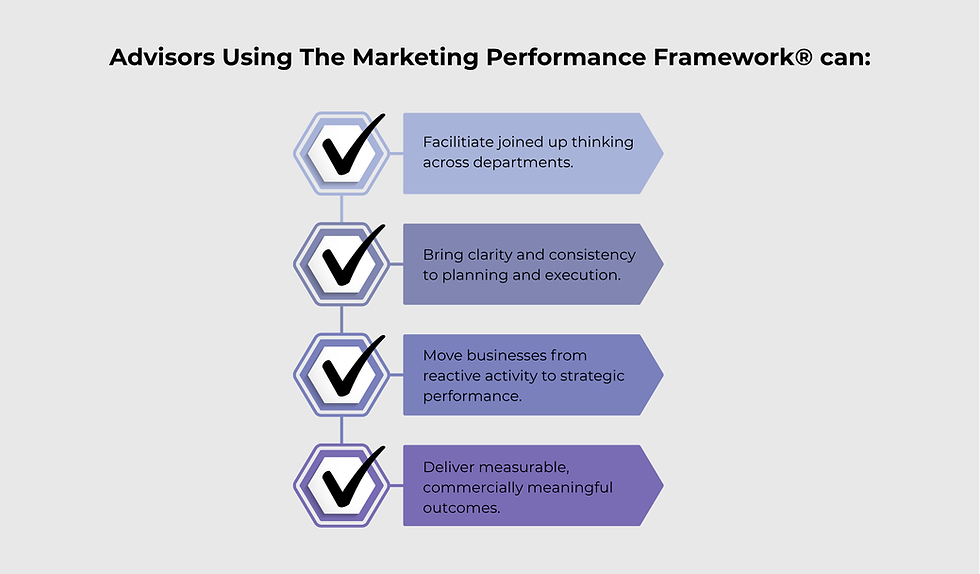
By introducing a structured SME marketing strategy supported by a framework like TMPF, advisors can:
Facilitate joined-up thinking across departments.
Bring clarity and consistency to planning and execution.
Move businesses from reactive activity to strategic performance.
Deliver measurable, commercially meaningful outcomes.
This shifts the role of an advisor from tactical support to strategic partner. And in a crowded market, that differentiation matters!
Unlike ad hoc marketing plans, TMPF provides a repeatable, business-wide system for SMEs and their consultants. Instead of delivering isolated outputs, advisors become the partner who connects marketing, sales, and team performance into a single, effective system.
The Impact of Alignment on Sales Performance
When alignment is achieved, the impact on sales performance is immediate and measurable.
With the right structure and support:
Messaging becomes clearer - improving conversion rates.
Leads are more relevant - increasing efficiency.
Sales teams gain confidence - because they understand the strategy.
Conversations become more consistent - building trust with prospects.
Most importantly, sales teams can see the direct link between marketing activity and revenue. This removes frustration and replaces it with focus. Instead of questioning the quality of leads or the direction of campaigns, sales teams become active participants in a connected process that supports them in achieving better results.
The Impact on Team Performance and Engagement
The benefits of team engagement marketing extend far beyond sales.
When marketing is structured and linked throughout the organisation:
People understand the “why” behind their work.
Clarity leads to more consistent execution.
Accountability increases
Duplication and confusion are reduced.
Engagement becomes natural – not forced. When people can see how their work contributes to growth, they don’t need motivating - they’re already invested.
This is where a structured marketing management process has a real cultural impact. It doesn’t just improve outputs - it improves how teams think, collaborate, and perform together.
Practical Insight: 3 Signs Your Client Has an Alignment Problem
Sales blames marketing for poor leads.
Marketing can’t clearly demonstrate ROI.
Teams are busy - but results are inconsistent.

If these sound familiar, the issue isn’t effort. It’s alignment.
Final Thought: It’s Not About Doing More - It’s About Connecting What Already Exists
Most SMEs already have the ingredients they need for growth:
Marketing activity
Sales effort
Knowledge and expertise
A capable, committed team
The challenge isn’t a lack of effort. It’s a lack of connection.
Without alignment, even the best teams can struggle to deliver consistent results. But when marketing, sales, and team performance are connected through a structured process, something shifts.
Clarity replaces confusion. Focus replaces frustration. And performance improves - often faster than expected!
If you are working with clients who are busy but not seeing results, the issue may not be what they’re doing — but how it all connects.
If you want to move from delivering activity to driving measurable performance for your clients, now is the time to explore how The Marketing Performance Framework® can support you.
As an advisor, by partnering with Performance for Sales you gain access to a tried and tested system to help your SME clients build that all important link between marketing, sales, and performance.


